Home › Concrete Sidewalk and Walkway
Add safe, attractive access to your home with a new concrete sidewalk in Conway, AR. We pour front walkways, garden paths, and replacement sidewalks that meet local standards and drain properly. Our team focuses on smooth surfaces, clean edges, and correct slopes to prevent trip hazards and pooling water around your property.
Conway Concrete Company provides professional concrete sidewalk throughout Conway, AR, Arkansas and the surrounding area. Our licensed, insured crew delivers safe, clean, on-time work with a free estimate before anything begins. Call (501) 358-5548 or request your free quote.
Concrete Sidewalks Built for Conway Neighborhoods
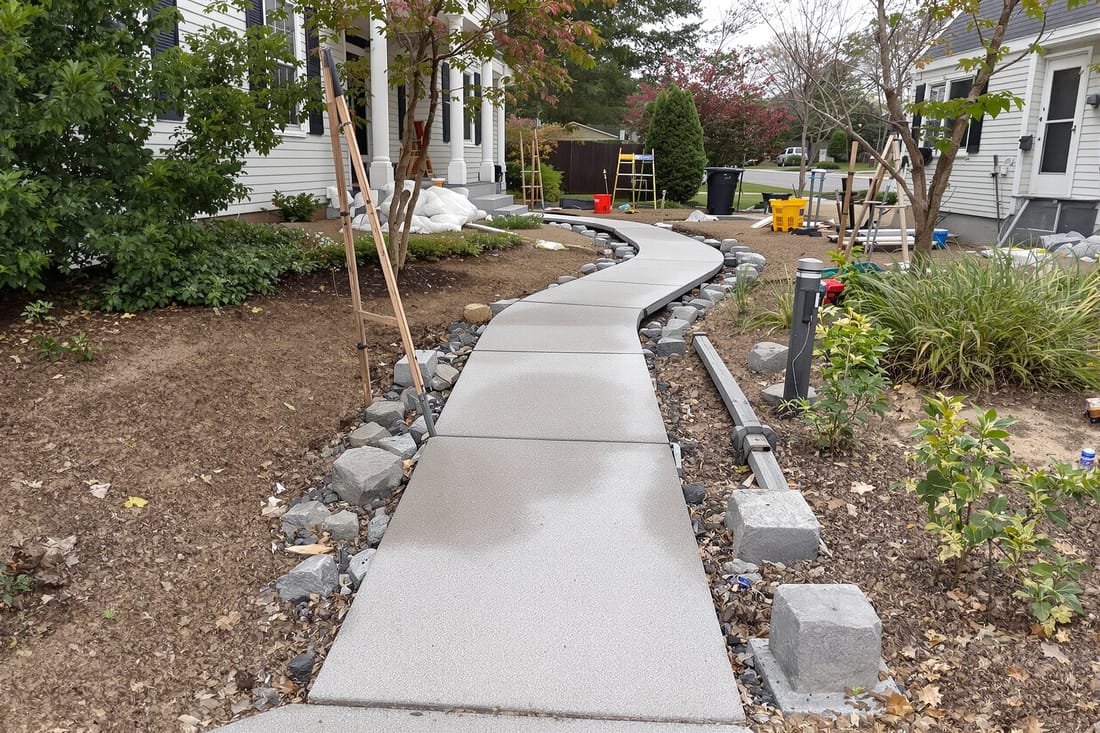
Sidewalks around Conway take a beating from summer heat, tree roots, and shifting clay soil. Conway Concrete Company builds concrete sidewalks and walkways that hold up to our local conditions and still look clean years later. Whether you are replacing a trip hazard along your driveway in Centennial Valley, adding a front walk in an older Conway neighborhood, or tying into an existing city sidewalk, we plan the pour around how your property actually drains and moves.
When we look at a sidewalk project, we start with how people will use it. A narrow path from the driveway to the front door needs different spacing, finish, and slope than a long sidewalk along a busy corner lot on Prince Street. We also pay attention to where water currently runs after a Conway afternoon storm, then set elevations so the new concrete sidewalk sheds water away from your house, garage, and flower beds instead of funneling it toward them.
Most residential sidewalks we pour in Conway are 4 inches thick with 3,000 to 3,500 PSI concrete. In spots that see heavier use, like RV parking spurs or mower crossings, we often recommend 5 inches. We can add fiber reinforcement in the mix or install steel reinforcement where there is more movement risk, such as fill dirt near new construction or cut-and-fill lots around west Conway.
How We Install a Concrete Sidewalk or Walkway in Conway, Step by Step
A solid sidewalk starts with the ground under it. Conway Concrete Company begins by calling Arkansas One Call if we are working near the street or property edges, then we mark utilities so we do not hit anything when we dig. We remove grass, roots, and soft topsoil until we reach firm ground, usually 4 to 6 inches below the planned surface. On many Conway lots we add and compact crushed stone to help with drainage and to reduce settling in our clay soils.
Next we set forms with treated lumber, staked tight so they do not move when the concrete is placed. This is where we fine tune the slope. For walkways near front doors in Conway subdivisions, we typically set a gentle fall of about 1/8 inch per foot away from the house. Along streets, we match the city sidewalk grade if you are tying into an existing section. We double check this with a level, not by eye, so rainwater runs off and does not pond.
Before the truck arrives, we install any reinforcement that is needed. Fiber mesh mixed into the concrete works well for most residential sidewalks in Conway and helps control surface cracking. In problem spots, like over old tree roots or where a previous sidewalk has settled, we may add wire mesh or rebar. We also place expansion material where your sidewalk meets a driveway, garage slab, or city sidewalk to give the slabs room to move without breaking the edges.
When the concrete shows up, we place it right away so it does not start to set in the truck. We spread and screed it to the top of the forms, then float it to bring up a smooth paste. For most concrete sidewalks, we cut control joints every 4 to 5 feet while the mix is still soft. These joints are where the concrete is allowed to crack in a straight line, instead of randomly across the surface. We finish with a light broom texture so the sidewalk is not slick in the rain, then edge the sides for a clean, rounded look that resists chipping from weed trimmers.
Design Options for Sidewalks and Walkways Around Your Conway Home
A sidewalk does not have to be a plain strip of gray. Conway Concrete Company can build curved or widened walkways, small landing pads, and decorative sections that break up a long run of concrete. On newer homes around Conway, especially in subdivisions like St. John's or Chapel Creek, we often pour a 4-foot main walk with a flared entrance pad by the front porch. This makes the walk more comfortable when two people use it at the same time and gives room for planters or seating.
We offer several finish options. A standard broom finish is the most practical for most Conway sidewalks. It has good traction when wet and hides minor dirt and leaf stains that are common under oaks and maples. If you want something more decorative around patios and backyard paths, we can use stamped concrete for short sections, borders, or bands. This can imitate stone or brick without the maintenance of individual pavers that tend to move on Conway's clay soils.
We can also add integral color or use a colored release with stamping to keep the sidewalk from looking too bright against older brick homes in central Conway. Light grays and sand tones are popular because they stay cooler in the Arkansas sun and blend with both red and tan brick. Around pools or slopes, we may suggest a rougher broom pattern or a sandblasted finish for extra grip.
For homeowners dealing with tree roots from big shade trees, a common issue in older Conway areas, we can design the route to gently curve around trunks, add root barriers in the trench, or widen the control joints over likely movement points. This costs less and looks better than constantly patching lifted slabs.
What Affects Concrete Sidewalk Cost in Conway, AR
The cost of a concrete sidewalk project in Conway depends on more than just square footage. At Conway Concrete Company, we look at access, demolition, base work, and finish details. Removing an old cracked sidewalk, hauling off debris, and working around existing landscaping can add labor. If we have to wheelbarrow concrete around the house because a truck cannot reach the backyard, that also adds time.
Soil conditions matter too. Many Conway lots have clay that holds water. If the ground is soft or has been filled in, we may recommend extra base material or thicker concrete. That adds cost, but it also prevents the sidewalk from settling and creating trip hazards a few years later. On sloped lots, more forming and step transitions may be needed to keep the walkway comfortable and safe.
Finish options and reinforcement also affect price. A simple broom-finished sidewalk using standard concrete is the most budget friendly. Fiber reinforcement adds a small amount but can save money on long-term repairs. Decorative borders, curves, or stamped panels cost more because they take more forming and finishing time. We go over all of this in a written estimate so you can see where each dollar is going.
For homeowners inside Conway city limits, we also look at whether we are working inside the public right of way. If you are replacing the strip of sidewalk between your yard and the street, we may need to match city standards on thickness, width, and slope. This does not usually add a lot of cost, but it does affect how we set the forms and which mix design we order.
Common Sidewalk Problems in Conway and How We Prevent Them
Most of the sidewalk issues we are called to fix in Conway come down to three things: poor base preparation, no control joints, and water running the wrong way. When a sidewalk is poured directly on topsoil or uncompacted fill, the concrete settles at different rates. That is when you see panels tilt toward the house or create toe stubs at each joint. Conway Concrete Company avoids this by compacting the subgrade, adding a gravel base where needed, and refusing to pour on mud or saturated ground.
Random cracking is another complaint. All concrete will crack over time, but where and how it cracks can be controlled. We set joint spacing based on sidewalk thickness and local temperature swings, and we cut or tool these joints at the right depth while the concrete is in the right stage of set. On longer Conway sidewalks, we may also saw cut joints the next morning for cleaner lines and better crack control.
Drainage is the other big issue. We often see older walks in Conway that tilt back toward the house, especially near garage entries that have settled. When we replace those, we correct the slope so water moves toward the yard, street, or a drain. If your yard already has drainage problems, we can coordinate the sidewalk layout with downspout extensions or small surface drains so everything works together instead of fighting each other.
Before we leave, we explain curing to the homeowner. In Conway's summer heat, we usually apply a curing compound to keep moisture in the slab, or we return to wet cure the surface for the first few days. We also give clear instructions on when you can walk, move furniture, or drive over edges with mowers. Proper early care reduces surface dusting and scaling, which means your concrete sidewalk looks better and lasts longer.